Friday, October 14, 2011

Blog Post 7: Diffraction Experiment with Simulation


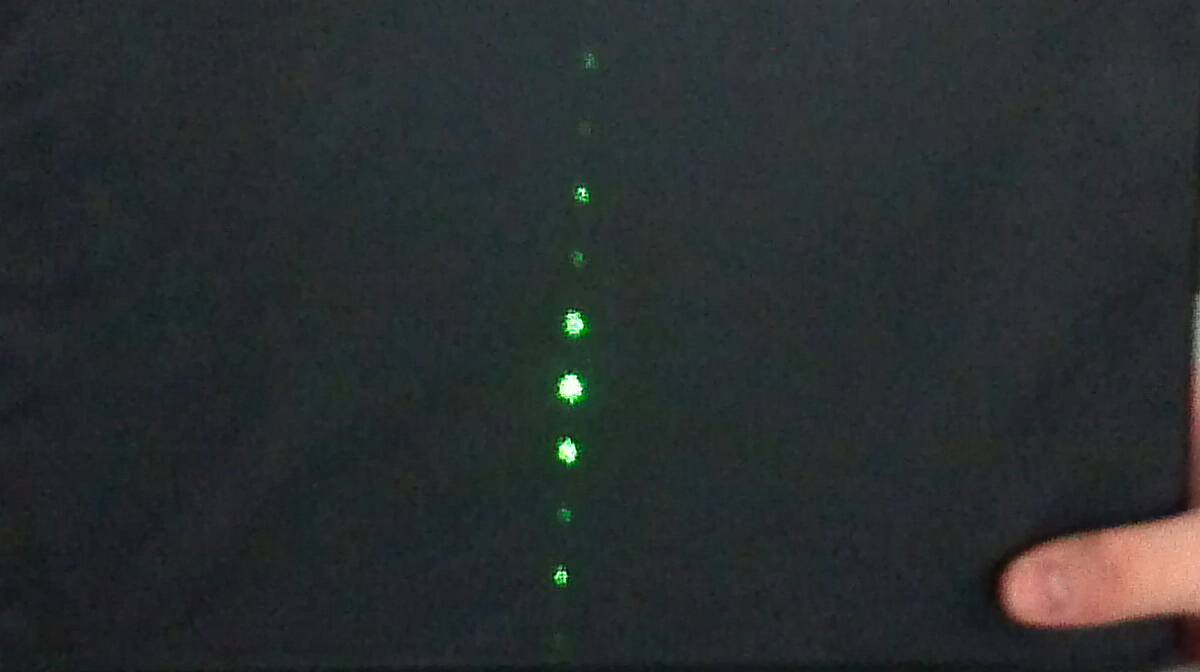
The numbers on this image correspond to the positions
Position 1

The distance between line patterns for green = 1 cm, red = 1.25 cm
Position 2

The distance between line patters for green = 1 cm, red = 1.25 cm
Position 3

The distance between line patters for green = 1.5 cm, red = 2 cm
Position 4

The distance between line patters for green = 1.5 cm, red = 2 cm

Position 1 and 2 are 80nm apart with a thickness of 60nm.
Position 3 and 4 are 120nm apart with a thickness of 60nm.

Tuesday, October 11, 2011

Blog Post 6: Good Nano Websites

http://nano.gov/
http://www.foresight.org/nano/
http://www.nanotech-now.com/
http://www.nanowerk.com/
http://www.nanotechproject.org/
http://www.p2i.com/technology
http://domino.research.ibm.com/comm/research.nsf/pages/r.nanotech.html
http://www.crnano.org/whatis.htm
http://www.nanoforum.org/educationtree/electronics/electronics-computers.htm
http://www.azonano.com/news.aspx?newsID=13144

Tuesday, October 4, 2011

Blog Post 5: Wave Interference Simulation Activities

1. Measure the wavelength of two drops of different amplitude, leave frequency constant.
    low amplitude  : 4.34 cm
    high amplitude : 4.34 cm

2. Measure the wavelength of two drops with different frequency, leave amplitude constant.
    low frequency  : 6.52 cm
    high frequency : 0.98 cm

3. Explain your results for question 1 and 2.
    As you change the amplitude the wavelength does not change just the height of the wave, but when you change the frequency then the faster you have the frequency the smaller the wave length becomes.

4.  Introduce a second faucet for the next set of questions.
- measure the wavelength of the two drips, in cm
- then measure distances from each drip to the 6 constructive interference points and report these values, cm
- explain the observation you have on the distance comparisons to the constructive interference points to the wavelength of the water wave.
Wavelength of the two drips : 2.5 cm

X -> A ~ 3.47        Y -> A ~ 3.43
X -> B ~ 3.48        Y -> B ~ 6.11
X -> C ~ 6.10        Y -> C ~ 3.52
X -> D ~ 6.09        Y -> D ~ 8.59
X -> E ~ 6.03        Y -> E ~ 6.06
X -> F ~ 8.60        Y -> F ~ 6.08

The distance between the constructive interference points are about the same to a little bit bigger than the wavelength of the individual drip. 

Tuesday, September 27, 2011

Blog Post 3: Waves

Questions:
1. Fast up and down
2. High energy
3. 0.98 Hz
4. 3.7 Hz
5. 0.98 Hz
6. 58 cm
7. 16 cm
8. Energy is proportional to frequency because the higher the frequency the more energy is needed to make it.  If there is high energy then there is a lower wavelength but if there is low energy there is a higher wavelength.

Blog Post 2: Unit Cell of NaCl

Unit Cell
Height, width, length : 1.104 nm or 11.04 angstroms or 1.104 * 10^-9 m

Mass
Number of molecules in one cube of salt : 5.9454 * 10^18
Mass of grain of salt : 5.77 * 10^-4

Dimension
 A grain of salt is 1.25 * 10^17 cubic nm

Tuesday, September 20, 2011

Blog Post 1: Describe 10 nm and mole of atoms

How can one really describe something so small?  It would take 1 billion of them just to make a meter, something one could walk in a second.   Since Menomonie to Des Moines is about 1000 km and that is also 1 billion millimeters then walking 10 mm of that trip would be the same as 10 nm.

On the other spectrum we have a mole which can be a huge number.  A mole come from the number of particles in 12 grams of carbon-12.  This number is about 6.02 * 10^(23).  So if you were to have a mole of people that would be 6.02 * 10^(23).  This number is so big its hard to truly comprehend its size.  If 1 mole of pennies was given out to all the people in the world then each person would have enough money to spend 1 million dollars an hour for the rest of their life.  The US dept right now is almost 15 * 10^(12) this number is not even close to a mole.